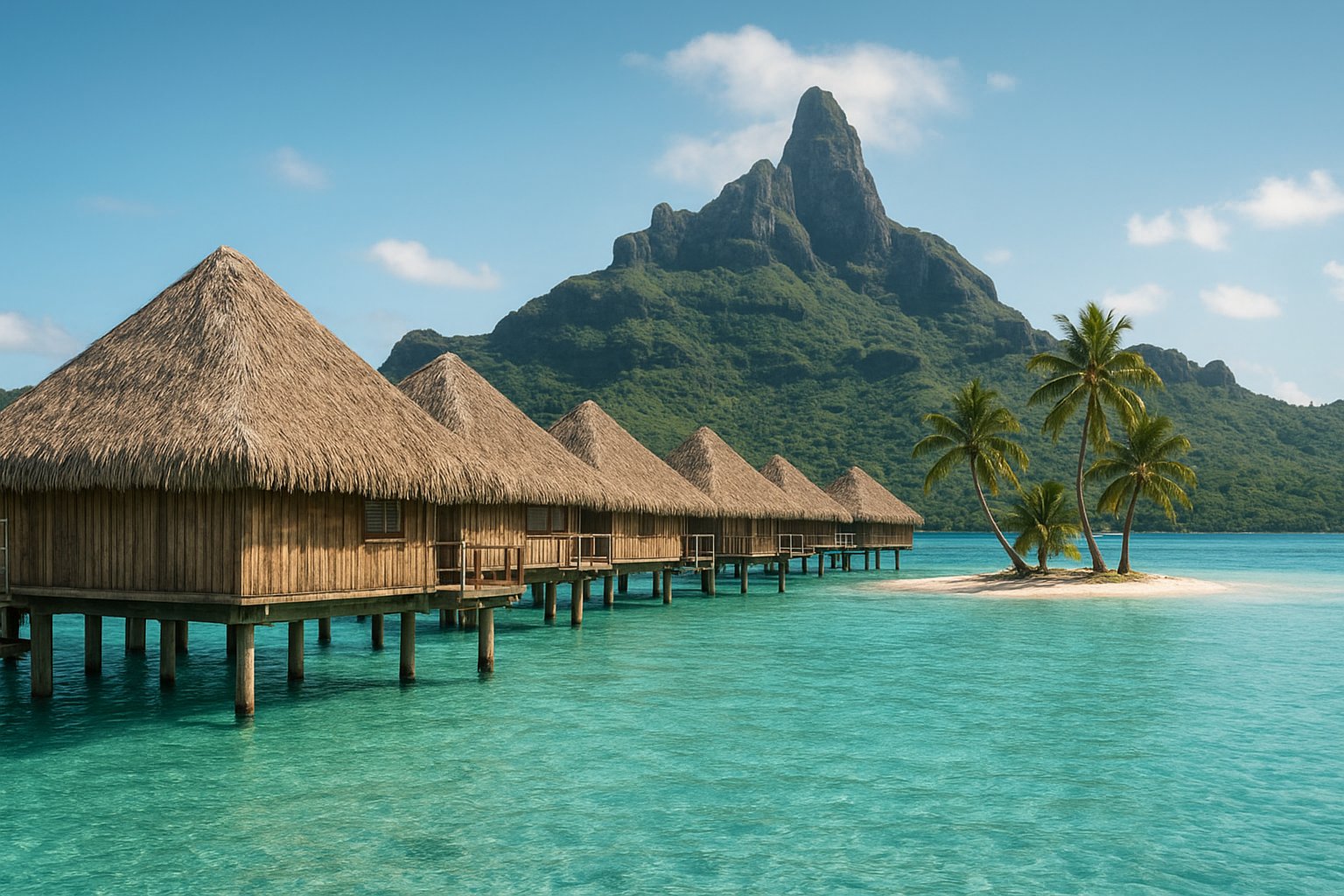
The distinctive underwater sights worth planning around. Descriptions are curated planning info — always verify local access, rules and conditions before you set out.
📍 Moorea, in the Society Islands off Tahiti
A wide, shallow lagoon inside a barrier reef, with coral gardens in wadeable depth, stingrays and blacktip reef sharks over the sand, and the two big bays — Cook's and Opunohu — cutting into the island. Much of it is a short swim from a beach or a few minutes by boat, which makes it arguably the most accessible lagoon snorkeling in the country.
The ray and shark aggregations at the lagoon's sandbars exist because operators have fed them for years, and the practice is controversial locally — do not touch or grab the animals, follow whatever rules your operator and the local authorities currently set, and do not expect the encounter to be guaranteed on any given day.
📍 Bora Bora, in the Society Islands
A barrier reef enclosing a broad lagoon of coral gardens and channels — the classic turquoise water — with rays and small sharks over the sand shallows. Snorkeling is mostly by boat between the motus, with the best coral along the lagoon's inner edge.
Coral gardens near the busiest hotel frontages see a lot of traffic: go with an operator who uses moorings and keep your fins off the coral. Check the current near the lagoon's pass before swimming anywhere close to it.
03
Rangiroa's passes (Tiputa & Avatoru)
Megafauna point📍 Rangiroa atoll, Tuamotu Archipelago
The two passes into Rangiroa's lagoon are the atoll's famous water: on an incoming tide the flow funnels through and carries you past grey reef sharks, dolphins, turtles and big schools, in some of the clearest water in the country. It is drift snorkeling at scale, on an atoll whose lagoon is a small sea in its own right.
Be honest with yourself about this one: these are current-heavy drift snorkels in open, deep, fast-moving water, and they are not beginner or casual-swimmer conditions. Go only with a local operator who reads the tide — the window is the incoming flow, and if the tide is wrong there is no snorkel at all.
📍 Tikehau atoll, Tuamotu Archipelago
A large, very shallow lagoon with coral heads scattered across pale sand, patrolled by reef fish and the occasional ray, with manta rays reported at the atoll's cleaning and feeding areas. Quieter and far less developed than the Society Islands, it is the low-key lagoon day of the Tuamotus.
Manta sightings are never guaranteed — they follow plankton and tide, not a schedule — and much of the lagoon is ankle-to-waist deep over coral, so watch your fins and never stand on the bottom.
05
Fakarava's south pass (Tumakohua)
Reef📍 Fakarava atoll, Tuamotu Archipelago
Fakarava is a UNESCO-listed biosphere reserve atoll, and its south pass is known for dense fish life and large numbers of grey reef sharks, with coral along the pass walls. The pass fills and empties with the tide, which is exactly why the life concentrates there.
The south pass is drift water with serious tidal flow and is normally dived rather than snorkeled; the realistic snorkel options at Fakarava are the lagoon-side coral and drift lines on a favourable tide, and only with a local guide. Treat any pass as a tide decision, not an itinerary item.