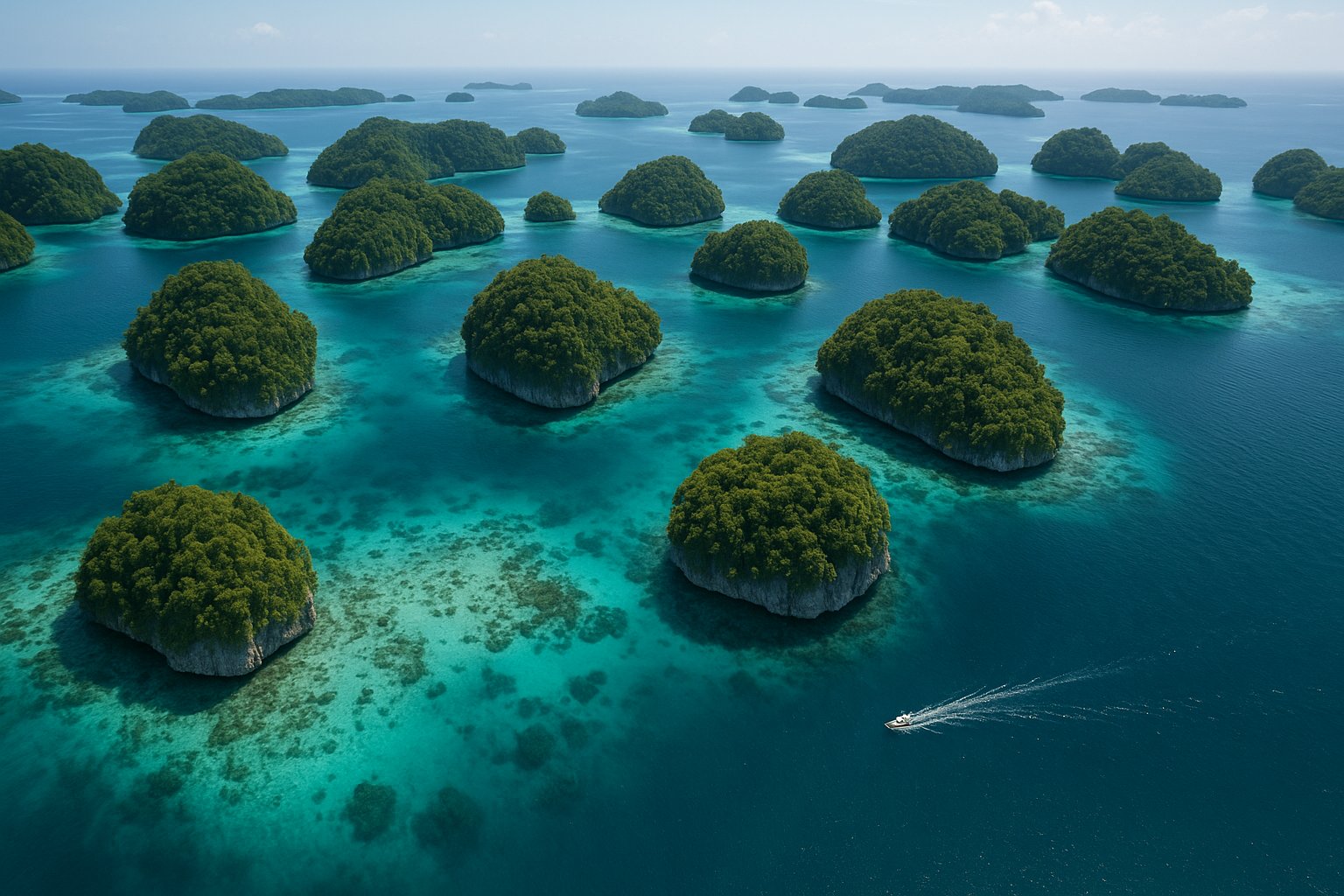
The distinctive underwater sights worth planning around. Descriptions are curated planning info — always verify local access, rules and conditions before you set out.
📍 The Rock Islands, off Urukthapel (Ngeruktabel)
A sheltered inlet among the Rock Islands with shallow coral, calm water and the karst walls that give the whole archipelago its look. The coral here sits shallow enough to snorkel properly rather than glance at, and the bay is protected enough to be workable on a windy day when the outer reef is not an option.
The Rock Islands are managed water: boats need permits, and some bays are closed or restricted at different times. Go with a local operator who knows what is currently open rather than assuming any bay is fair game.
📍 Off Mecherchar (Eil Malk), the Rock Islands
A shallow patch reef named for its giant clams — several of them large and very old — sitting in clear, calm water alongside coral heads and reef fish. It is among the easiest and most reliable snorkels in the Rock Islands, and it pairs naturally with a lake stop on the same island.
The clams are living, protected animals: look, do not touch, and never stand on the coral around them. Follow your guide's directions on where the boat may moor.
03
Jellyfish Lake (Ongeim'l Tketau)
Lagoon📍 Mecherchar (Eil Malk), the Rock Islands
A marine lake cut off from the sea, reached by a short, steep trail across the island, where golden jellyfish drift in the water. Their sting is not felt by people, and snorkeling among them has been one of Palau's signature experiences for decades. The lake's jellyfish population is fragile and has been hit by drought and warm-water events before, so its status changes over time.
Verify before you plan around it: the lake has been closed to visitors at times to let the jellyfish recover, and permission, the trail and the rules — no scuba gear, no lifting jellyfish out of the water, no sunscreen on the swim — are all locally managed. Confirm what is currently allowed with a local operator or the park office.
📍 The Rock Islands, near Mecherchar
A shallow, enclosed patch of the Rock Islands where fine white calcium-rich mud clouds the water. It is a swim-and-mud novelty rather than a reef: the draw is the milky water and the mud itself, and boats stop here as a break between coral sites.
There is very little reef life here and the bottom is soft mud — do not stand on it, do not stir it up around other swimmers, and treat the mud as a bit of fun rather than anything with a claimed health benefit.
05
German Channel
Megafauna point📍 Between Ngemelis and the barrier reef, southern Rock Islands
A channel cut through the barrier reef in the German colonial era, now one of Palau's best-known sites — manta rays at cleaning stations along the channel edges, plus grey reef and whitetip sharks. The megafauna is the point; the coral and reef fish along the channel are the setting.
This is current-carried water and the cleaning stations sit at diving depth, so the mantas and sharks are mostly seen by divers. A snorkel here is a boat-and-tide call, not a guaranteed encounter — it depends on the operator judging the flow safe. And be clear about the rest of Palau's fame: the celebrated walls such as Blue Corner are dive sites, not snorkel sites.