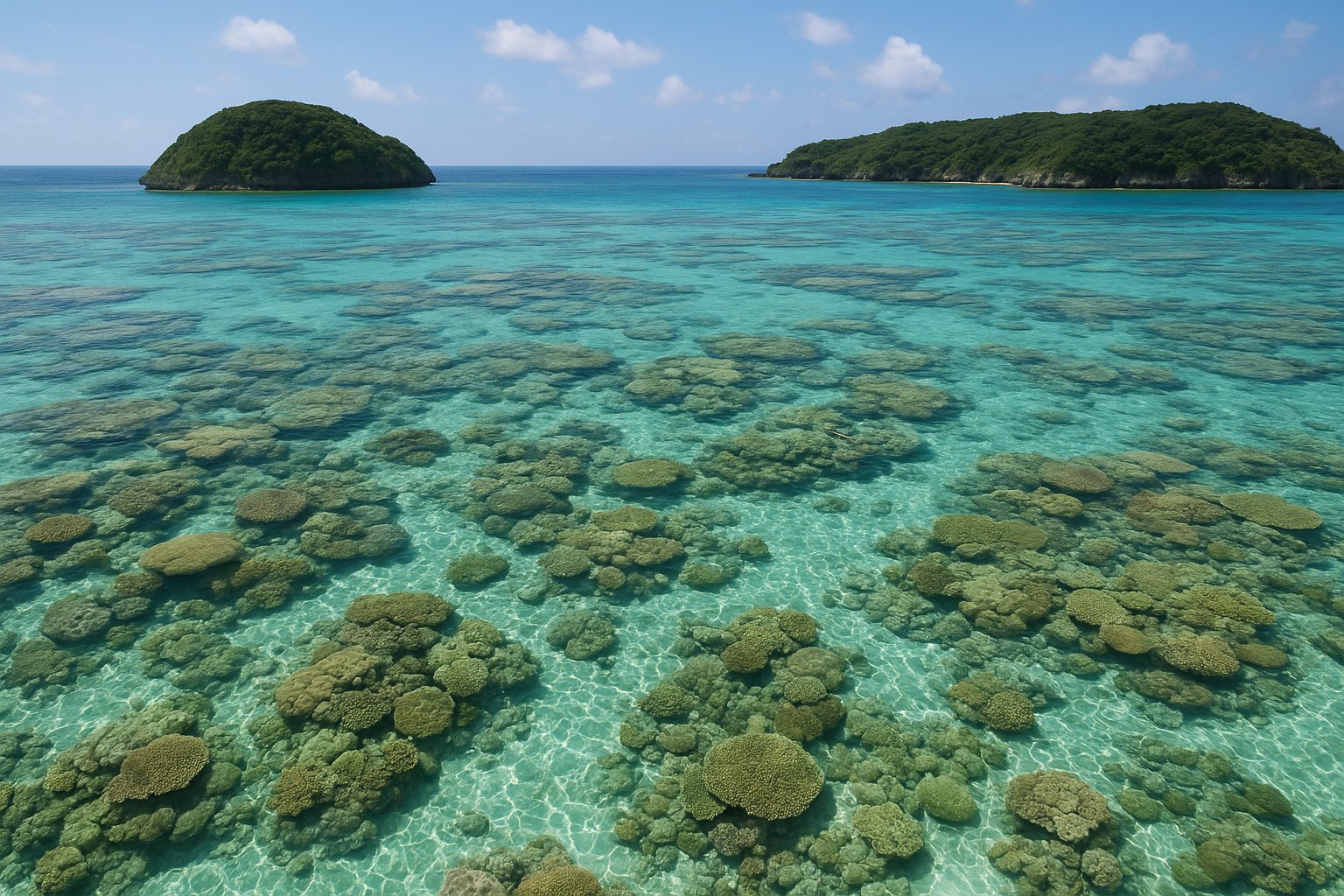
The distinctive underwater sights worth planning around. Descriptions are curated planning info — always verify local access, rules and conditions before you set out.
01
The Kerama Islands
Marine reserve📍 Kerama Islands National Park, roughly 40 km west of Naha, Okinawa
The clear-water island group behind Okinawa's 'Kerama blue' shorthand: Zamami, Tokashiki and Aka and their smaller neighbours, fringed with coral in water that is often exceptionally transparent. Sea turtles are the signature — they graze the seagrass and reef shallows — and the whole group sits inside Kerama Islands National Park, designated in 2014.
Reached by ferry or high-speed boat from Naha's Tomari port, and the crossings are weather-dependent, so build in a spare day. It is a national park with its own visitor rules: confirm current restrictions locally, and give turtles real distance rather than swimming over them.
02
Cape Maeda and the Blue Cave
Sea cave📍 Onna Village, west coast of Okinawa main island
Okinawa's most famous shore snorkel. A rocky entry at Cape Maeda leads out to the Blue Cave, a sea cave whose interior glows blue in the morning light, with coral and reef fish on the reef outside it. This is genuinely walk-in snorkeling rather than a boat day, which is why it is the island's introduction to the water for so many people.
Read the caveats: this is the busiest snorkel site on the island, the entry crosses rock and coral and gets difficult in swell, and access at the cave is periodically restricted for safety and conservation. Check the day's sea state and local rules before you commit, and go early to beat the groups.
03
Sekisei Lagoon and Shiraho Reef
Reef📍 Between Ishigaki and Iriomote, Yaeyama islands
The Yaeyama group's big reef system: the Sekisei Lagoon, one of Japan's largest coral lagoons, holding dense patch and fringing reef across a wide, shallow, island-studded stretch of sea. On Ishigaki's Shiraho coast the reef flat carries a rare blue-coral community, and the shallow lagoon water is clear enough to snorkel properly.
The Yaeyama islands are a flight from Naha to Ishigaki or Miyako first. The best water is a boat ride out, much of the lagoon is shallow coral you must not stand on, and the tide windows matter — go with a local guide, and verify current conditions and any restricted zones before you plan a day.
📍 North-west Ishigaki island, Yaeyama
The most photographed bay in the Yaeyama islands: a near-enclosed, vivid blue bay whose colour comes from the clarity and depth of the water over coral and sand, worked by glass-bottom boats. It is the scenery stop of an Ishigaki itinerary rather than a snorkel site.
Important and often missed: swimming is not permitted in Kabira Bay itself, so do not plan a snorkel here. Treat it as the view, do the actual snorkeling on the island's other coasts or on a boat trip, and confirm current local rules, which can change.
05
The Miyako island group and Yabiji
Reef📍 Miyako Islands, between Ishigaki and Okinawa main island
A third island group in the prefecture, with its own lagoon and fringing reef. Offshore from Ikema lies Yabiji, a large submerged coral system that surfaces only at extreme low water — the local 'phantom island' — with shallow coral and clear water over it and boat trips running out to it.
Boat access only, and entirely tide- and weather-dependent: Yabiji is a shallow, exposed reef, so it is a fair-weather day with a local operator or not at all. Verify the tide, the sea state and what your boat actually visits.